A Practical Guide to E-Invoicing in UAE
Master e-invoicing in UAE with this practical guide. Understand the PINT AE standard, meet FTA compliance deadlines, and prepare your business for the mandate.
Posted by
 Tadqiq Team
Related Reading
A Practical Guide to E-Invoicing in the UAE
Master e invoicing in UAE. This guide breaks down the PINT AE standard, FTA compliance deadlines, and how to prepare your business for the 2026 mandate.
Read →
A Practical Guide to HS Codes for Dubai Customs & E-Invoicing Compliance
Discover hs codes dubai customs and learn how accurate classifications speed up UAE trade, FTAs, and customs clearance.
Read →
A Guide to TRN Verification FTA for UAE E-Invoicing
Master TRN verification FTA for UAE e-invoicing. Our guide covers manual checks, APIs, and batch validation to ensure VAT compliance and avoid penalties.
Read →
The UAE is overhauling its tax system, and at the centre of this change is a new mandate for e-invoicing in UAE. This new rule will apply to every single business registered for VAT, fundamentally changing how you issue and report invoices. Getting this right from the start is crucial for staying compliant and streamlining your operations.
Think of it less as a simple switch from paper to digital and more as a complete redesign of how your company creates, sends, and reports invoices to the Federal Tax Authority (FTA). This guide is your practical roadmap to navigating the mandate, understanding the technical standards, and ensuring your business is ready well ahead of the deadline.
Understanding the New E-Invoicing Mandate
For business owners and finance managers in the UAE, this is the most significant change to tax administration since VAT was introduced. The new system requires all Business-to-Business (B2B) and Business-to-Government (B2G) invoices to be issued in a specific electronic format and reported to the FTA.
Let's be clear: this isn't just about emailing a PDF. A compliant e-invoice is a structured data file, typically XML, that machines can read and process automatically. The goal is to increase transparency, combat tax fraud, and make VAT reporting more accurate for both businesses and the government.
Here’s what you absolutely need to know:
- It’s Mandatory: Every business registered for VAT in the UAE must comply.
- There’s a Standard: Your invoices must adhere to the PINT AE standard, the UAE's specific version of the global Peppol framework.
- It’s a Phased Rollout: The government is rolling this out in stages, beginning in July 2026, to give businesses time to prepare.
If your business is still getting its tax affairs in order, you might find our guide on how to register for VAT in the UAE useful first.
Understanding Your E-Invoicing Timeline
The UAE isn't flipping a switch on e-invoicing overnight. Instead, the Federal Tax Authority (FTA) has outlined a clear, phased implementation. This gives businesses a structured runway to prepare their systems and processes, avoiding a last-minute scramble.
The first step is to identify where your business fits into this timeline, as deadlines are based on annual revenue. Larger companies are required to comply first, allowing the FTA to test and refine the system with high-volume taxpayers before it becomes mandatory for everyone.
Key Dates for Your Compliance Calendar
The process begins with a voluntary pilot phase on 1 July 2026. This is an excellent opportunity for proactive businesses to get ahead of the curve.
The first mandatory deadline is for large taxpayers—those with an annual revenue of AED 50 million or more—who must be live by 1 January 2027. Following that, all other VAT-registered businesses must comply by 1 July 2027.
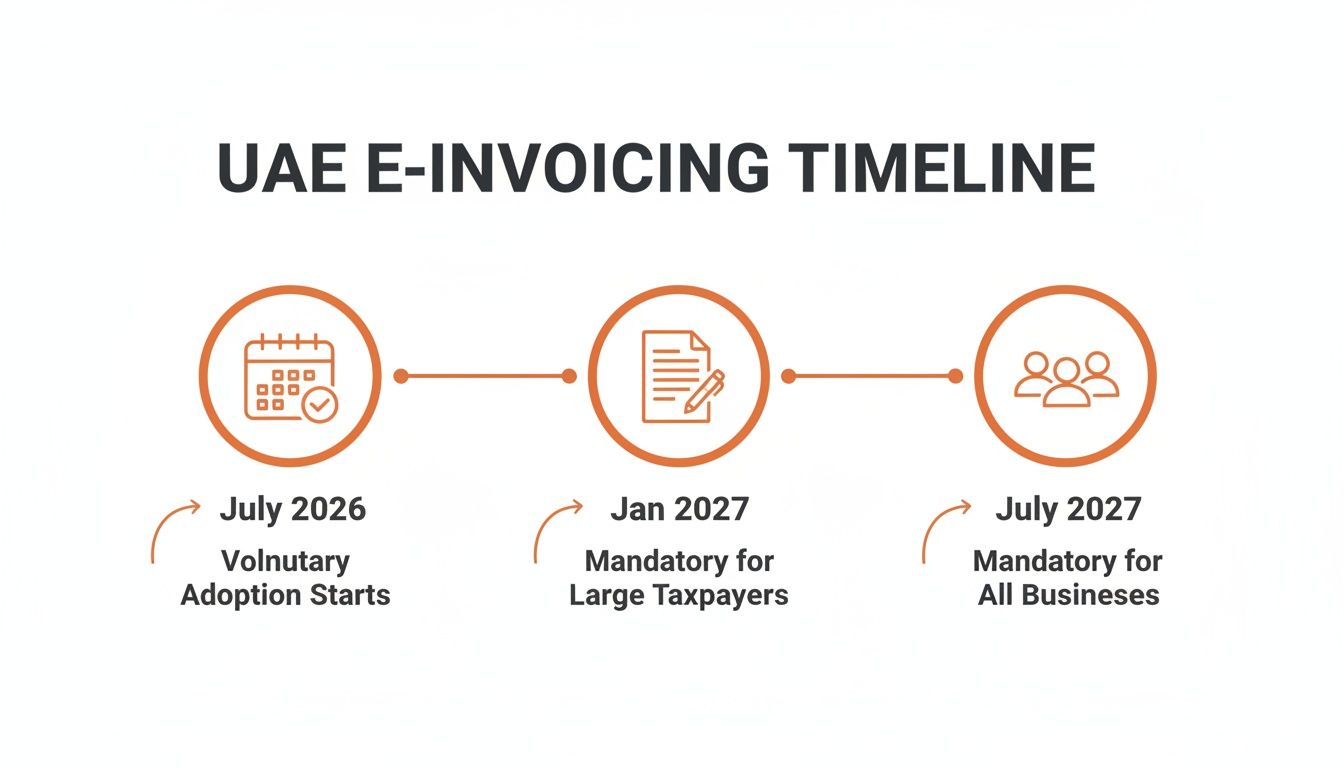
This timeline highlights a clear progression, ensuring everyone has a window to prepare, though that window is shorter for larger businesses.
UAE E-Invoicing Mandate Timeline
This table summarises the key dates and requirements for different business categories under the UAE e-invoicing mandate. It's your quick-glance guide to staying compliant.
| Key Milestone | Deadline | Applicable Businesses | Requirement |
|---|---|---|---|
| Voluntary/Pilot Phase | From 1 July 2026 | All VAT-registered businesses | Early adoption and system testing on a voluntary basis. |
| ASP Appointment (Large) | By 31 July 2026 | Annual revenue ≥ AED 50 million | Must officially appoint an Accredited Service Provider (ASP). |
| Mandatory Go-Live (Large) | From 1 January 2027 | Annual revenue ≥ AED 50 million | All B2B e-invoices must be issued and reported through the FTA's system. |
| ASP Appointment (Others) | By 31 March 2027 | Annual revenue < AED 50 million (VAT-registered) | All other applicable businesses must appoint their ASP. |
| Mandatory Go-Live (Others) | From 1 July 2027 | Annual revenue < AED 50 million (VAT-registered) | The mandate extends to all remaining VAT-registered businesses. |
As you can see, the deadlines for appointing an Accredited Service Provider (ASP) are set well before the go-live dates. This is a crucial step you cannot afford to miss.
Appointing Your Accredited Service Provider
Choosing and appointing an Accredited Service Provider (ASP) is a non-negotiable part of this process. An ASP is an official intermediary—a third-party licensed by the FTA to handle the secure exchange of e-invoices between your business and the government's central platform.
You cannot send an invoice directly to the FTA; all submissions must flow through your chosen ASP. This makes meeting the appointment deadline just as critical as the go-live date itself. Getting your technology sorted is only half the battle; ensure your business data is clean and accurate, starting with a valid Tax Registration Number. For a refresher, check out our guide on the TRN number in the UAE and its importance.
Getting to Grips with the PINT AE Technical Standard
At the heart of the UAE’s new e-invoicing system is a technical standard called PINT AE. Think of it as the official language that every electronic invoice must speak to be understood by the Federal Tax Authority (FTA). This isn't just about the file format; it's a rigid set of rules dictating the structure and content of your invoices.
For your finance team, getting this right is non-negotiable. An invoice that doesn't meet the PINT AE standard will be rejected, leading to payment delays, compliance issues, and administrative headaches. Mastering its components is key to a smooth transition.
The Blueprint and the Inspector
To simplify this complex topic, think of PINT AE as having two parts that work together: a blueprint and a quality inspector. Both are essential for getting your invoice approved.
- The Blueprint (XSD Schema): The XML Schema Definition (XSD) is the architectural plan for your e-invoice file. It defines the mandatory structure—what information must be included, where it must go, and in what sequence.
- The Inspector (Schematron Rules): Schematron rules go a step further. While the XSD checks the structure, Schematron validates the logic and accuracy of the information within that structure. For example, it will check that your VAT calculation is correct or that the invoice date precedes the payment due date.
For an e-invoice to be valid, it must pass both XSD and Schematron checks. Failing either means the invoice is not compliant with FTA compliance rules.
Critical Data Points You Cannot Get Wrong
While every field on an e-invoice matters, a few common areas are responsible for most validation errors. Nailing these details is fundamental to a painless e-invoicing process. Your systems must be configured to generate this data perfectly, every time.
A single mistake, like a misplaced digit in a Tax Registration Number or an incorrect currency code, can cause an entire invoice file to be rejected. This highlights the importance of precision and pre-submission checks to catch errors before they reach the FTA.
Here are some of the most critical data points under PINT AE:
- Tax Registration Numbers (TRN): Both the seller's and the buyer's TRNs must be included and correctly formatted. Our guide on how to perform FTA TRN verification walks you through the steps to ensure accuracy.
- Correct Date Formats: All dates, like the issue date and supply date, must follow the specific ISO 8601 format (YYYY-MM-DD).
- Specific VAT Calculations: The system is unforgiving. Line-level totals, VAT amounts, and the final invoice total must add up perfectly. Even the smallest rounding discrepancy will lead to rejection.
- Mandatory Codes: You must use standardised codes for everything from currencies (e.g., AED) and unit quantities (e.g., PCE for piece) to specific tax categories.
The UAE's e-invoicing framework, built on Peppol standards with PINT AE customisations, demands strict XML compliance for all B2B and B2G invoices starting July 2026. You can discover more insights about these requirements on rtcsuite.com. Getting these technical details right is the foundation of your success with the new mandate.
Understanding the E-Invoicing Ecosystem
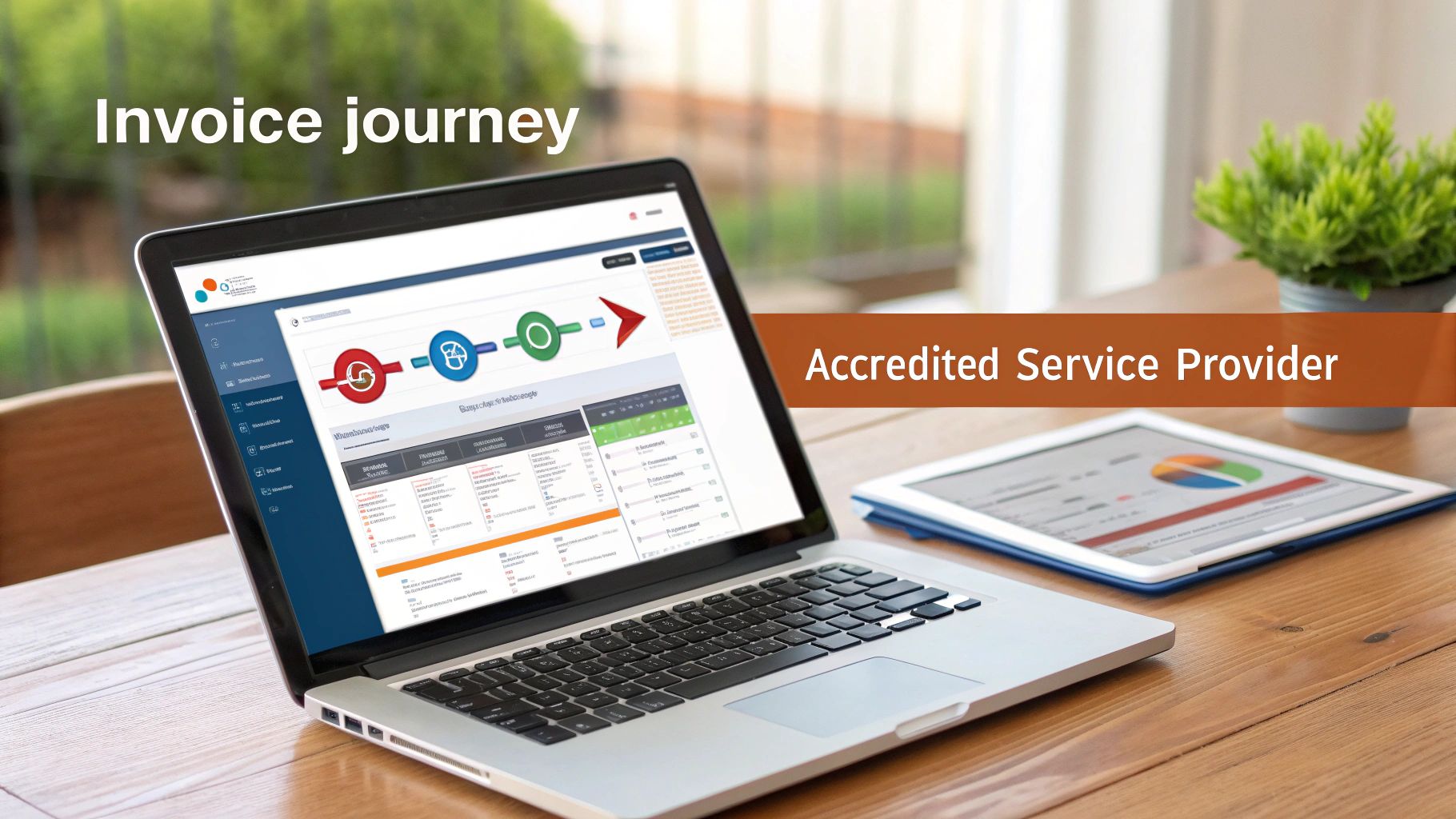
To master e-invoicing in UAE, you need to understand how all the pieces fit together. Think of it as a supply chain for your invoice data, where every link must be perfect for the invoice to successfully reach the Federal Tax Authority (FTA).
A single mistake can cause a rejection, leading to delayed payments and hours of corrective work for your finance team. Let’s map out the entire journey an e-invoice takes from your system to the government's.
The Source of Truth: Your ERP System
Everything begins with your Enterprise Resource Planning (ERP) or accounting software. Whether you use Zoho, Wafeq, Oracle, or another platform, this is where the invoice is created—with the customer's TRN, line items, VAT calculations, and totals.
However, most ERPs were not built to generate an XML file that meets the strict PINT AE standard. They hold the correct information, but not in the format the FTA requires. This is often the first point of failure.
The Official Gateway: The Accredited Service Provider
Under the UAE mandate, you cannot send your invoice directly to the tax authority. Every e-invoice must pass through an Accredited Service Provider (ASP). These are private companies, approved by the government, that act as a secure bridge between your business and the FTA's central platform.
Your ASP is the final gatekeeper, validating your invoice file one last time before submission. If it fails their checks, it's sent back to you. This makes choosing the right ASP and preparing your files correctly a critical step.
The Complete Data Journey
When you see the full data flow, it becomes clear where things can go wrong and why a proactive approach is essential.
- Creation in Your ERP: Your team creates an invoice in your accounting software with all commercial and tax details.
- Export and Pre-Validation: The data is exported, typically as a CSV or Excel file. This is your golden opportunity to use a pre-validation tool like Tadqiq. It acts as an early warning system, checking your file against all FTA compliance rules and identifying errors in plain English.
- Conversion to PINT AE XML: Once your data is clean, it’s converted into the official PINT AE compliant XML format that the FTA system understands.
- Submission to the ASP: The properly formatted XML file is sent to your chosen ASP. Because you’ve already pre-validated it, the chances of it passing their checks are extremely high.
- Final Reporting to the FTA: The ASP runs its final checks and securely transmits the approved e-invoice to the FTA's platform.
This workflow reveals the secret to success: validating your invoice before it reaches the ASP is the single best way to guarantee a smooth, error-free process and maintain FTA compliance.
How to Prevent Common E-Invoice Rejection Errors
A rejected e-invoice is more than an inconvenience; it disrupts your cash flow and creates hours of administrative rework. For any finance team, preventing rejections is fundamental to business continuity. The first step to a perfect submission record for UAE e-invoicing is understanding common pitfalls.

Here, we'll break down the most common validation errors under the PINT AE standard, explain why they happen, and show you how to fix them at the source. A few process refinements now will save your team significant headaches later.
Invalid Tax Registration Number (TRN)
This is one of the top reasons for an e-invoice to be rejected. The FTA's system relies on the TRN to identify both the seller and the buyer. An imperfect number stops the entire process.
Often, the error is a simple typo, an extra space, or a missing digit. The moment your e-invoice hits the FTA's system, it’s checked against their master database, and any mismatch results in instant failure. The fix is to make TRN verification a regular part of your data management, ensuring your records are always up-to-date and maintaining solid FTA compliance.
Mismatched Financial Calculations
The PINT AE Schematron rules are incredibly strict about mathematics. A discrepancy of even AED 0.01 between the sum of line items and the final invoice total will get your submission rejected. This precision applies to the subtotal, discounts, and the final VAT UAE calculation.
These errors often stem from rounding issues within an ERP system, especially with discounts or unit prices with multiple decimal places. To solve this, configure your invoicing software to handle rounding with the absolute precision required by FTA standards. Always double-check that all components add up perfectly before submission.
Incorrect Date Formats and Sequences
Another frequent issue is the date format. The PINT AE standard requires all dates to follow the ISO 8601 format: YYYY-MM-DD. Using a common format like DD/MM/YYYY is a guaranteed error.
It's not just about formatting; it's also about logic. The system checks if dates are sequential and logical—for instance, an invoice cannot be dated in the future. The best way to prevent this is to set your ERP’s default date export to the correct format and build simple business rules to flag illogical date sequences.
Common PINT AE Validation Errors and Solutions
This table is your quick guide to diagnosing and fixing some of the most common validation errors.
| Error Code (Example) | Common Cause | How to Fix It | Prevention Tip |
|---|---|---|---|
| BR-AE-10 | Invalid TRN format or number for the buyer or seller. | Verify the TRN against the FTA portal and correct it in your customer/vendor master data. | Implement a regular, automated TRN verification process for all your business partners. |
| BR-CO-09 | Invoice total (payable amount) doesn't equal the sum of its parts. | Recalculate the sum of line items plus VAT minus allowances. Adjust your ERP's rounding settings. | Conduct a pre-flight check on invoice calculations before exporting the data from your system. |
| BR-S-05 | A required code (e.g., currency, unit of measure) is missing or invalid. | Ensure you are using official codes, such as "AED" for currency or "PCE" for pieces. | Create a master list of approved codes and map them correctly in your ERP's export template. |
| BR-CL-20 | An incorrect VAT category code is used for a specific item. | Match the item's VAT treatment with the correct code (e.g., 'S' for standard rate, 'Z' for zero-rated). | Train your finance team on the correct VAT codes and create cheat sheets for common transaction types. |
By embedding these checks into your daily workflow, you can shift from a reactive approach to a proactive one, ensuring your e-invoices pass validation on the first try.
Your E-Invoicing Readiness Checklist
Getting ready for mandatory e-invoicing in the UAE is not a last-minute task. A smooth rollout requires careful planning and a structured approach to manage the change, avoid launch-day issues, and ensure full FTA compliance.
Think of this checklist as your practical roadmap to align your people, processes, and technology. What may seem like a compliance burden can become a genuine upgrade to your operations.
Phase 1: Foundational Assessment
Before making any changes, you need to understand your current state. This phase is about auditing your existing invoicing processes to identify gaps. A clear picture of your starting point makes the entire project manageable.
Start by mapping your entire invoice-to-cash process, from invoice creation in your ERP to customer delivery and VAT logging. This exercise often uncovers hidden bottlenecks. Then, consult your IT team or ERP provider to confirm your system can export all necessary invoice data cleanly.
Phase 2: Data and Process Preparation
Once you understand your current setup, it's time to prepare your data and internal processes. This is the most critical stage, as clean data is the bedrock of successful e-invoicing. Nearly all validation errors stem from poor data quality.
Here’s what to focus on:
- Data Cleansing Project: Start a formal project to scrub your customer and vendor master files. Verify every Tax Registration Number (TRN), confirm legal names are correct, and standardize addresses.
- VAT Logic Review: Review your system's VAT calculations meticulously. Are rounding rules precise? Is the tax treatment for different services configured correctly? For a refresher, our guide on how to calculate VAT in the UAE provides detailed examples.
- Internal Training: Begin training your accounts teams on what’s coming. Explain why data accuracy is now so crucial and introduce them to the concepts of structured data and validation.
Phase 3: Technology and Partner Selection
With clean data and refined processes, you can confidently select the right technology partners. This phase is about choosing the tools that will bridge the gap between your ERP and the FTA's system.
Your first major decision is selecting your Accredited Service Provider (ASP). As your official gateway to the FTA, this choice is crucial. Evaluate their technical support, pricing, and integration capabilities. Remember, you must appoint your ASP by an official deadline months before you need to send your first e-invoice.
Relying solely on your ASP for validation is a common mistake. When you send a flawed file, it gets rejected, starting a frustrating cycle of fixing and resubmitting. This is why a pre-submission validation step is a game-changer. A platform like Tadqiq acts as your safety net, allowing you to test and perfect your e-invoice files before they go to your ASP. It catches errors early, explains them clearly, and helps ensure your files pass on the first try, saving you immense time and frustration.
Your E-Invoicing Questions Answered
With the deadline for e-invoicing in UAE approaching, businesses have many practical questions. We’ve compiled clear answers to the most common queries we hear from finance teams and business owners.
What Exactly Is PINT AE?
PINT AE is the official technical standard—the blueprint—for every e-invoice in the UAE. It is a specific version of the global Peppol framework that the Federal Tax Authority (FTA) has mandated. Adhering to its precise XML format and business rules is non-negotiable; failure to do so will result in invoice rejection.
Will I Have to Change My Accounting Software?
Not necessarily, but you will need to verify its capabilities. The key question is whether your current system can produce invoice data in the required PINT AE XML format. Some platforms may need reconfiguration, while a simpler solution is to export data in a format like CSV and use a pre-validation service. A tool like Tadqiq can take your simple file, convert it to compliant XML, and validate it before it ever goes to your ASP.
My Revenue Is Below AED 50 Million. When Do I Need to Be Ready?
While the first mandatory wave begins on 1 January 2027 for businesses with revenues of AED 50 million or more, your deadline is not far behind. If you are a VAT-registered business below that threshold, you must appoint your ASP by 31 March 2027, with a mandatory go-live date of 1 July 2027. Start preparing now to avoid compliance issues. To get the full picture, it’s worth brushing up on our complete guide on what is VAT in UAE.
What's the Difference Between an ASP and a Pre-validation Tool?
This is a critical distinction. An Accredited Service Provider (ASP) is your official, FTA-certified gateway for submitting e-invoices to the government's tax system. A pre-validation tool, like Tadqiq, acts as a crucial safety net between your accounting system and the ASP. It meticulously checks your invoice data against FTA rules, flagging errors in plain English so you can fix them proactively. This ensures your submissions are right the first time, preventing rejections from your ASP.
Ready to streamline your e-invoicing? Try Tadqiq today.