What Is Corporate Tax In UAE A Guide For Business Owners
Understand what is corporate tax in UAE with this clear guide. Learn the rates, who pays, and how it connects to VAT and e-invoicing for full FTA compliance.
Posted by
 Tadqiq Team
Related Reading
A Practical Guide to E-Invoicing in the UAE
Master e invoicing in UAE. This guide breaks down the PINT AE standard, FTA compliance deadlines, and how to prepare your business for the 2026 mandate.
Read →
A Practical Guide to HS Codes for Dubai Customs & E-Invoicing Compliance
Discover hs codes dubai customs and learn how accurate classifications speed up UAE trade, FTAs, and customs clearance.
Read →
A Guide to TRN Verification FTA for UAE E-Invoicing
Master TRN verification FTA for UAE e-invoicing. Our guide covers manual checks, APIs, and batch validation to ensure VAT compliance and avoid penalties.
Read →
For anyone doing business in the UAE, the arrival of Corporate Tax is more than just a new line item on the balance sheet—it’s a fundamental change to the financial landscape. At its core, it’s a direct tax on the net profits earned by most companies and commercial operations, brought into law by the Federal Decree-Law No. 47 of 2022.
This move signals a major evolution from the UAE's long-standing tax-free reputation, placing new compliance duties squarely on the shoulders of nearly every business.
The New Reality of UAE Corporate Tax
The introduction of Corporate Tax isn't a minor tweak; it's a significant shift for every organisation in the UAE. This guide is designed to cut through the complexity and give you a clear, practical understanding of what the new law means for your day-to-day operations, financial reporting, and long-term planning.
Consider this your roadmap to navigating the new rules with confidence.

We’ll break down exactly who needs to pay, how much you’ll owe, and when those deadlines are. Getting a firm grip on these rules is the essential first step towards maintaining perfect compliance with the Federal Tax Authority (FTA).
The system itself has been structured to be business-friendly, especially for smaller companies. You can see this in the tiered tax rates, which tie your obligations directly to your profitability. This approach helps align the UAE with global best practices while still nurturing the pro-business environment it's known for.
For accountants, finance managers, and AP teams, adapting means going back to basics and building a solid understanding from the ground up.
So, What Exactly Is This New Corporate Tax?
At its simplest, the UAE's Corporate Tax is a direct tax placed on the net profits of businesses. Think of it as the government's way of creating a more structured, sustainable national income stream, bringing the UAE more in line with international tax practices while still keeping its famous pro-business spirit intact.
The system was cleverly designed with a two-tier structure, specifically to shield small and medium-sized businesses (SMEs) from heavy tax burdens right out of the gate. This approach lets smaller companies breathe, grow, and reinvest their earnings back into the business, which is a win-win for everyone.
Getting To Grips With The Tax Rates
The rates themselves are refreshingly straightforward. There are just two numbers you need to remember.
Here’s a quick breakdown of how the UAE's corporate tax tiers work for most businesses:
UAE Corporate Tax Rates At A Glance
| Taxable Income Bracket (AED) | Applicable Corporate Tax Rate |
|---|---|
| From AED 0 up to AED 375,000 | 0% |
| Above AED 375,000 | 9% |
Let's put this into a real-world example. Say your business makes a taxable profit of AED 400,000. You won't pay a dirham of tax on the first AED 375,000. The 9% rate only kicks in for the amount above that threshold, which in this case is just AED 25,000.
This new tax system officially came into play for financial years starting on or after 1 June 2023, thanks to Federal Decree-Law No. 47 of 2022. It was a major step for a country long known for its tax-free environment and created a whole new world of compliance for companies operating here.
The All-Important Difference: Accounting Profit vs. Taxable Income
One of the first things you need to wrap your head around is that your 'accounting profit' isn't the same as your 'Taxable Income'. They might sound similar, but the Federal Tax Authority (FTA) sees them very differently.
Your accounting profit—the bottom line you see on your standard financial statements—is just the starting point. From there, you have to make specific adjustments to arrive at the final number the FTA actually cares about: your taxable income. This means adding back certain expenses that aren't tax-deductible (think certain client entertainment costs or specific penalties) and making other tweaks required by the Corporate Tax Law.
Getting this distinction right is absolutely fundamental; it’s the foundation for your entire tax calculation. It's just as critical as understanding the basics of other taxes, a topic we cover in our guide to VAT in the UAE. Nail this initial calculation, and you're setting yourself up for a much smoother compliance journey.
Who Needs to Pay Corporate Tax?
So, who actually needs to pay Corporate Tax in the UAE? Figuring out if your business is on the hook is the first, most critical step. The new law casts a wide net, so it’s safest to assume most businesses are included unless they fit into a very specific exemption.
This means every business owner and finance manager out there needs to take a close look at their operations.
The law uses a specific term: 'Taxable Person'. This is the official label for anyone who needs to register and potentially pay tax. It’s a broad category designed to cover pretty much any commercial activity happening in the country.
Who Is Considered A “Taxable Person”?
A Taxable Person is anyone, or any entity, running a business in the UAE. It boils down to two main groups.
-
Resident Persons: This is the most straightforward category. It includes any company incorporated or legally established right here in the UAE. It also covers foreign companies if their day-to-day management and key decisions are made from within the UAE, even if they were set up elsewhere.
-
Non-Resident Persons: This applies to foreign companies that aren't managed from the UAE but still have a solid presence here. A non-resident becomes a Taxable Person if they have a 'Permanent Establishment' in the country (think a branch office or a fixed place of business) or if they earn income that originates from the UAE.
And it’s not just about companies. If you’re an individual with a freelance permit or any other business licence under your own name, you're also considered a Taxable Person and have to follow the same rules.
Who Is Exempt From Corporate Tax?
While most businesses are covered, the law carves out some clear exemptions for specific entities, mostly to support public services and key sectors of the economy. Knowing if you qualify for an exemption is just as important as knowing if you’re taxable.
Getting an exemption isn't always automatic. For many, it involves applying to the Federal Tax Authority (FTA) and meeting some very strict conditions. If you fail to keep up with those conditions, you could lose your exempt status and find yourself facing a tax bill.
Here’s a quick rundown of the main groups that are exempt:
- Government Entities: This includes federal and local government bodies and their various departments.
- Government-Controlled Entities: These are companies fully owned and controlled by the government, but they must be specifically named in a Cabinet Decision to be exempt.
- Public Benefit Organisations: Charities and similar organisations listed in a Cabinet Decision are exempt, as long as they are genuinely serving the public good.
- Investment Funds and Real Estate Investment Trusts (REITs): These can qualify for an exemption, but they have to meet certain criteria, like being regulated and open to a wide range of investors.
- Extractive and Non-Extractive Natural Resource Businesses: Think oil and gas. These businesses are usually taxed at the Emirate level already, so they are exempt from the federal Corporate Tax.
For everyone else, the starting point should be to assume you are a Taxable Person. From there, you can assess your specific situation and figure out what you need to do to get registered and stay compliant.
Navigating Free Zone Rules And Small Business Relief
When it comes to the new corporate tax law, the special rules for Free Zones and small businesses are where things get really interesting. These are, without a doubt, the biggest areas for tax planning and efficiency. The government has clearly tried to support these crucial parts of the economy, but getting the benefits isn't automatic—it requires a close look at the details.
Many businesses set up shop in Free Zones for the favourable tax environment. But now, with corporate tax in the picture, it's a bit more complicated. Just having a Free Zone address doesn't mean you automatically pay 0% tax on everything. You first need to meet a specific set of criteria to be considered a Qualifying Free Zone Person (QFZP).
This flowchart maps out the basic logic of who falls under the UAE corporate tax net.
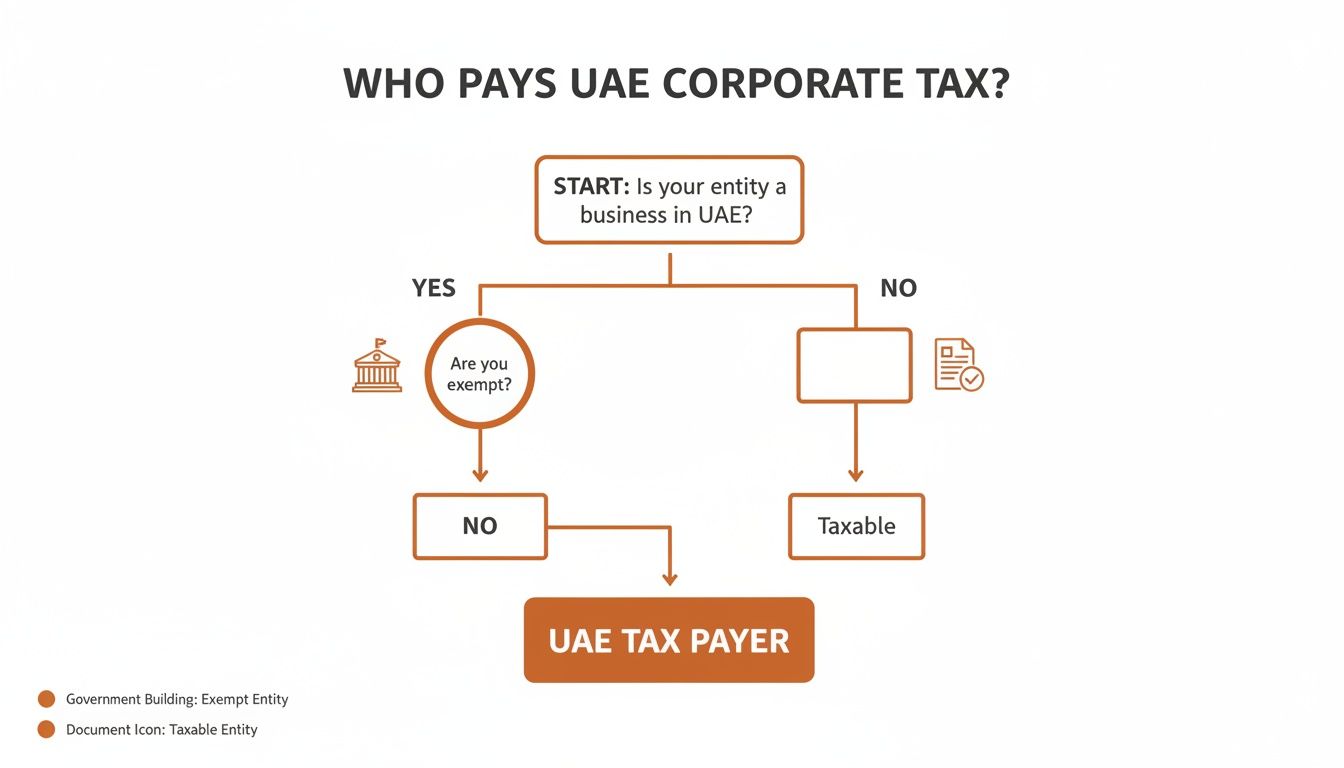
As you can see, while most businesses are taxable by default, there are important exceptions and special statuses, with Free Zones being a major one.
Qualifying Free Zone Persons
So, what does it take to become a QFZP and lock in that 0% rate? A business has to tick a few boxes, like maintaining "adequate substance"—meaning you have real operations with sufficient staff and assets here in the UAE. You also need to prepare audited financial statements.
Crucially, the 0% tax rate only applies to what the law calls ‘Qualifying Income’.
This generally covers:
- Income you make from doing business with other companies located in any UAE Free Zone.
- Revenue from exporting goods or services to customers outside the UAE.
Any income that falls outside these rules is considered 'Non-Qualifying Income' and gets hit with the standard 9% tax rate. A classic example would be selling goods directly to a customer on the UAE mainland from your Free Zone entity.
Small Business Relief
On a different note, the UAE has also rolled out Small Business Relief, which is a lifeline for smaller companies. It's a powerful tool that could mean a business pays zero corporate tax, even if it’s based on the mainland.
To put it simply, if your business's total revenue for the tax period is under AED 3 million, you're likely eligible for Small Business Relief. Meeting this condition allows you to elect to be treated as having no taxable income for that period.
This is a massive advantage for startups and SMEs. Think about it: a huge number of businesses in the UAE operate below this revenue level. The AED 375,000 threshold for the 9% tax bracket is one thing, but this relief provides a complete carve-out for a much larger group.
It’s also worth noting how this aligns with other compliance, like VAT UAE. Accurately tracking your revenue is everything, which is why your accounting and your TRN are so tightly linked. If you need a refresher, our guide on how to get your TRN number in the UAE can help.
Just be aware, this relief isn't for everyone. It’s not available to companies that are part of a large multinational group or whose main activity is simply holding shares or investments. And remember, it's not automatic—you have to actively claim it when you file your tax return.
Calculating Your Taxable Income and Key Deductions
Alright, let's move from the 'what' to the 'how'. Calculating your taxable income isn't as simple as just looking at the bottom line of your profit and loss statement. Your accounting net profit is just the starting point, not the finish line. From there, the Federal Tax Authority (FTA) requires a series of specific adjustments to get to the final number that your tax bill is actually based on.
Think of it as a reconciliation process. You'll need to add back certain expenses that aren't allowed for tax purposes and, in some cases, exclude specific types of income. Getting these adjustments right is absolutely crucial for accurate tax calculations and staying on the right side of the FTA.
Adjusting Your Accounting Profit
The path from your accounting profit to your taxable income is all about looking at your finances through the filter of the Corporate Tax Law. You’ll quickly find that some costs, while perfectly valid business expenses in your books, simply can't be used to reduce your tax bill.
Here are a few common examples of these non-deductible expenses:
- Fines and Penalties: Any penalties you've had to pay to a government authority? You can't deduct those.
- Donations: Contributions are only deductible if they're made to an approved charity or a recognised public benefit organisation.
- Some Client Entertainment Costs: The law is quite specific here. You can typically only deduct 50% of what you spend on client entertainment.
- VAT Payable: The VAT you owe to the FTA is not considered a deductible business expense for Corporate Tax purposes.
You'll also need to account for things like unrealised gains or losses. While your accounting standards might recognise these, tax law often waits until they are actually 'realised'. This careful adjustment process is vital for precision, much like the steps you have to take when you calculate VAT in the UAE.
Identifying Legitimate Deductions
So, what can you deduct? The guiding principle here is simple but strict: an expense must be incurred ‘wholly and exclusively’ for your business. This rule is in place to make sure that personal expenses don't get mixed in with legitimate commercial costs to artificially lower a company's taxable income.
The ‘wholly and exclusively’ rule is the cornerstone of tax deductions. If an expense serves both a business and a private purpose, only the portion directly related to the business is deductible. Meticulous record-keeping is your best tool for substantiating these claims during an audit.
This covers all the usual suspects: employee salaries, office rent, utility bills, the cost of raw materials, and your marketing budget, to name a few.
Carrying Forward Tax Losses
One of the most important strategic parts of the UAE's Corporate Tax law is the ability to carry forward tax losses. If your business ends up with a net loss in one financial year, you don't just have to absorb it. You can carry that loss forward and use it to offset taxable profits in your good years.
This is a massive help, especially for startups or businesses in industries that have natural peaks and troughs. It allows you to smooth out your tax obligations over the long run, which is a big plus for financial stability and future growth.
How Corporate Tax, VAT, and E-Invoicing Work Together
Corporate Tax doesn't operate in isolation. Think of it as one corner of a 'compliance triangle', deeply connected to the UAE's existing VAT system and the rapidly approaching federal e-invoicing mandate. For any forward-thinking finance manager or accountant, grasping this connection isn't just helpful—it's essential for FTA compliance.
This tight integration means the data you generate for one tax will directly feed into the others. Keeping accurate, validated financial records has moved from being good practice to being the absolute bedrock of your entire compliance strategy.
A Single Trigger for Broader Compliance
Let's look at a practical example of how these systems align. The mandatory VAT registration threshold is AED 375,000 in annual turnover. Coincidentally, that's the exact same figure that pushes your taxable income into the 9% Corporate Tax bracket.
This is no accident. The authorities have created a unified trigger point. When your business hits this level of economic activity, it's a clear signal that your compliance duties are about to expand significantly, covering both direct and indirect taxes.
E-Invoicing: The Digital Bedrock of Tax Reporting
The upcoming UAE e-invoicing mandate, expected to roll out from July 2026, is the final piece of the puzzle. This new rule will require businesses to issue and receive every e-invoice in a specific, structured digital format based on the PINT AE standard. Every single invoice will become a critical data point for both your VAT and Corporate Tax returns.
Accurate e-invoices are the bedrock of future tax compliance. Under the new mandate, the data from your invoices will serve as the primary source of truth for the FTA, making pre-validation an essential step to avoid errors in both VAT and Corporate Tax filings.
Since the 9% corporate tax on income over AED 375,000 kicked in, the compliance game has changed. For accountants and finance teams, integrating this new tax with the upcoming e-invoicing rules is paramount. The mandate will demand PINT AE compliant XML files containing precise tax and currency codes. A single invalid code could lead to e-invoice rejection, which in turn flags your accounts and increases the audit risk for your Corporate Tax returns.
You can learn more about how PINT AE impacts your business in our comprehensive guide to UAE e-invoicing.
Ultimately, getting ready for this interconnected system boils down to one thing: data integrity at the transaction level. Using a validation tool helps you proactively check your invoices against PINT AE rules, catching small errors before they snowball into costly filing mistakes.
Key Takeaways and Next Steps for Compliance
We've walked through the fundamentals of UAE Corporate Tax, from the 0% and 9% rates to figuring out if your business is a Taxable Person. The single biggest takeaway? Meticulous financial records, kept for at least seven years, are absolutely non-negotiable.
So, where do you go from here? It’s time to move from learning to doing.
Your first priority should be a thorough review of your current accounting systems. Are they up to the task? Next, it’s wise to sit down with a qualified tax advisor to map out your specific obligations. This isn't just about corporate tax in isolation; it's about preparing for the reality where tax compliance and digital invoicing are becoming two sides of the same coin. Think back to when you first had to learn how to register for VAT in the UAE; this requires the same level of preparation.
With Corporate Tax, VAT, and e-invoicing forming a compliance triangle, your invoice data quality directly impacts your audit risk. Clean data is no longer a goal—it's a requirement.
Your UAE Corporate Tax Questions, Answered
As businesses across the UAE get to grips with the new corporate tax, plenty of questions are popping up. It's completely normal. Here, we've tackled some of the most common queries we hear from business owners and finance teams to give you clear, straightforward answers.
When Is The First Corporate Tax Return Due?
You have 9 months from the end of your financial year to file your corporate tax return and settle the payment.
Think of it this way: if your company’s financial year closes on 31 December 2024, your deadline to file and pay is 30 September 2025. This gives you a good window to get your books in order and accurately calculate what you owe.
Can I Deduct Employee Salaries For Corporate Tax?
Yes, absolutely. Employee salaries, wages, and other related benefits are generally fully deductible when calculating your taxable income.
The rule of thumb here is that the expense must be incurred "wholly and exclusively" for business purposes. This is a standard principle to ensure you're only deducting legitimate business costs, not personal expenses.
How Does Corporate Tax Affect Freelancers?
If you’re a freelancer with a permit or any other business licence, you fall under the corporate tax system. However, the tax only kicks in if your annual net profit crosses the AED 375,000 threshold.
It's a crucial distinction: only your business income is potentially taxable at the 9% rate. Any personal salary you draw or income from personal investments remains outside the scope of corporate tax.
What Records Do I Need For Compliance?
The Federal Tax Authority (FTA) expects you to keep detailed financial records that back up every number on your tax return. There's no getting around good bookkeeping.
This includes things like:
- Your financial statements (whether audited or not).
- A complete trail of all sales invoices and purchase receipts.
- Relevant contracts and legal agreements.
The law is very clear on this: you must hold onto these records for at least seven years after the end of the tax period they relate to.
Ready to streamline your e-invoicing? Try Tadqiq today at tadqiq.ae.